Milk, Dairy and Grain Market Commentary
By Monica Ganley, Quarterra
Milk & Dairy Markets
The dairy markets remained unsettled this week as prices shifted under the weight of evolving supply and demand dynamics. Different commodities exhibited markedly divergent trajectories with milk powder and cheese finding traction while, butter and dry whey slid lower.

Nonfat dry milk was once again thrust into the spotlight as prices gained ground every day this week, rising as high as $1.745/lb. by the conclusion of Friday’s spot session. This marks an astonishing 16.75¢ increase over the week during which 32 loads of product changed hands. But despite a relatively active market, available supplies are seemingly insufficient to satisfy demand.

Dryers are running lean schedules as milk output slows seasonally and a stronger pull from manufacturers of other dairy products diverts skim solids away from milk powder production. Meanwhile, demand remains upbeat from both domestic and international sources, especially in Mexico. In some cases, buyers who eschewed powder at the eye-watering price levels experienced in spring and early summer have been forced to step back in to replenish stocks. Even though global prices have been rising, the recent spot market jump has once again made U.S. milk powder uncompetitive against alternative suppliers. Ultimately, this is likely to slow U.S. milk powder exports in the future.
Cheese markets were also able to move up this week, albeit at a more measured pace. Cheddar blocks gained a nickel on Monday and another half cent on Thursday, before giving up a penny on Friday to close out the week at $1.60/lb. Rising prices are diminishing the edge that U.S. product holds in the international arena, but market participants indicate that export demand for cheese remains robust. Strong export sales have been particularly critical considering weakness in domestic consumption. USDA’s Economic Research Service estimates that domestic cheese disappearance in June fell 1.5% year over year.

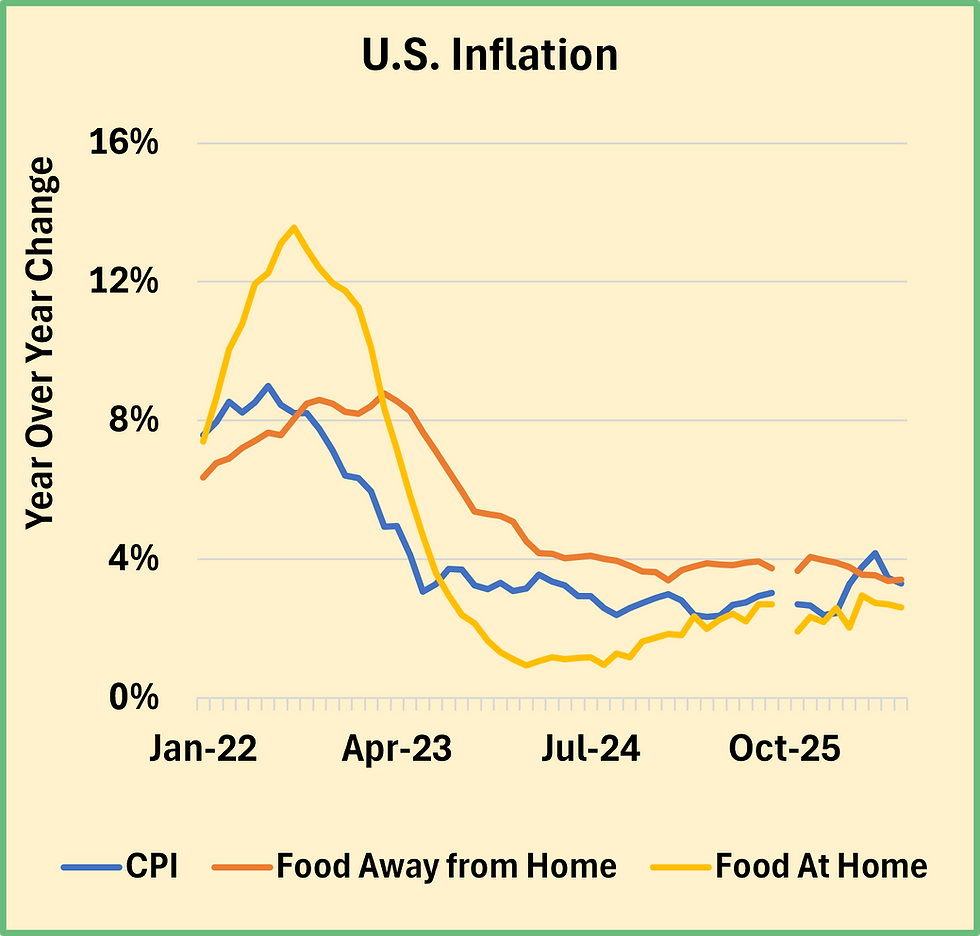
Consumers remain under economic pressure and continue to act cautiously. July data reported by the Bureau of Labor Statistics showed that headline inflation rose just 0.1% versus prior month though prices remain 3.3% higher than a year ago. However, the cost of eating out is outpacing that of the broader economy. The price of food consumed away from home was up 0.3% month over month and 3.4% higher than last July. Meanwhile, grocery prices actually fell 0.1% compared to June though they remain 2.6% above a year ago. As consumers work to stretch their household budgets, they are likely to eat out less frequently, which may further undermine consumption of certain dairy products, especially cheese.
Cheese production remains upbeat though market participants report that spot milk availability has tightened as bottlers begin to prepare for the upcoming school year. Healthy cheese production is throwing off an ample whey stream. Where possible, this raw whey is being used in the production of high value ingredients like whey protein isolate and whey protein concentrates (WPC) with a high protein percentage. But with production capacity for these products limited, there is still plenty of whey available for the manufacture of dry whey. Dry whey prices remain range bound, dropping just a half cent this week to 69¢ per pound. Notably, there is some evidence that the tireless upward trajectory of high value whey ingredients is starting to dissipate with prices mostly moving sideways in recent weeks.
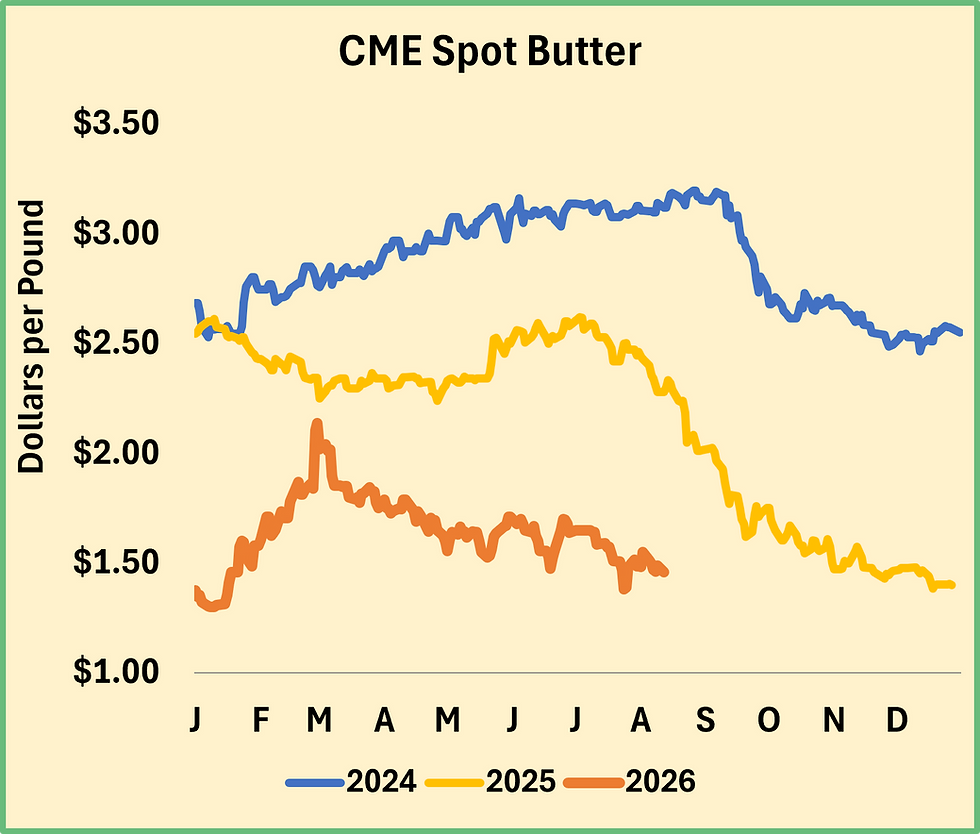
Butter prices remain under pressure, with the spot price giving up 5.25¢ over the week and closing out Friday’s session at $1.46/lb. Cream markets are dynamic but butter production is still upbeat and product is readily available, particularly for butter with 80% fat content. Further evidence of a well-supplied market are the 121 loads of product that traded at the CME this week. Fortunately, demand remains strong from both international and domestic buyers. With U.S. prices highly competitive against other suppliers, global buyers continue to demonstrate interest in U.S. product with a strong preference for butter with 82% butterfat. Domestic disappearance was up a hearty 8.4% year over year in June and the upcoming autumn and holiday baking season are likely to imbue the market with additional strength.
As the end of the summer comes into focus, Class I demand is starting to pick up. This is keeping tension in the market and tightening up the availability of spot milk, even as volumes remain upbeat overall. Temperatures vary across the country and are having an uneven impact on milk production. Some producers in the upper Midwest are reporting reprieve from excessive heat. Meanwhile, others in the East and West are still dealing with heat stress, which is being further compounded by smoke. Milk margins remain tight and easing beef prices are casting a layer of anxiety over producer economics.
Grain Markets
USDA released its August World Agricultural Supply and Demand Estimates (WASDE) report this week with minimal fanfare. A 2.3-bushel reduction in corn yields was compensated by an increase in acreage, leaving the production estimate for the 2026/27 crop year virtually unchanged at 16.013 billion bushels. Meanwhile, the soybean production estimate was increased to 4.519 billion bushels which, if realized, would represent the largest soybean harvest on record. But despite the WASDE release, it was really global affairs, and especially the ongoing conflict between Russia and Ukraine that drove prices upwards as traders expressed concern about export prospects from the Black Sea region. DEC26 corn settled at $4.72/bu. on Thursday and was trading in the $4.80s when we went to press on Friday. Soybeans followed a similar path with NOV26 soybeans settling at $11.825/bu. on Thursday and trading about a dime higher on Friday afternoon.

Comments