Milk, Dairy and Grain Market Commentary
By Sarina Sharp, Daily Dairy Report
Grain Markets
The dairy markets are singing the same song as they were last week, only louder. Dairy proteins are in demand, and prices continue to climb. But we’re making more cheese and butter than the market can absorb, and those markets are in retreat.
Strong demand and seasonally low output has tightened milk powder supplies. Dryers in the West are going full throttle, but in the Central region, dryers are running extremely light, except when outages at other processors temporarily boost production. USDA’s Dairy Market News reports that “demand in the Western region continues to outpace production” despite optimal output in California. USDA describes the market as “tight” and the price confirms it. CME spot nonfat dry milk (NDM) leapt 11ȼ this week to $2.08 per pound, retracing the uphill path it trod this spring, when FDA recalls dramatically tightened the U.S. milk powder market. But there are signs that the air is getting thin at this altitude. Some buyers are going hand-to-mouth, purchasing as little as possible in hopes of lower prices down the road. The futures forecast a decline. While the spot market is standing firm north of $2, October NDM futures remain south of $1.90, and prices fade quickly from there. The December NDM contract finished the week at $1.75. Skim milk powder (SMP) managed a steady showing at this week’s Global Dairy Trade (GDT) auction with an average winning price around $1.79, on par with deferred NDM futures but significantly below the CME spot market.

The narrative of the whey market remains the same, and the grooves on this broken record are getting deeper with each pass through the soundtrack. Consumers around the world are hungry for whey proteins, especially in their most concentrated formats. But heavy cheese production is spinning off more than enough whey to amp up whey powder output as well. Thankfully, whey powder exports are running strong, and CME spot whey powder has broken out to the upside. This week it climbed 2ȼ to 78ȼ and established a fresh 2026 high.

The cheese market is humming a very different tune. Exports are strong – and likely getting stronger at these values – but they’re not sufficient to absorb all the excess cheese created by the massive multi-year growth in U.S. cheese output. And, while U.S. cheese is by far the cheapest in the world, European merchants are keen to compete. At the GDT on Tuesday, mozzarella prices – a benchmark for Europe’s international sales – fell 6%. CME spot Cheddar blocks went a step further, notching a 7.5% decline. They plummeted 11ȼ this week to an eight-month low of $1.35.

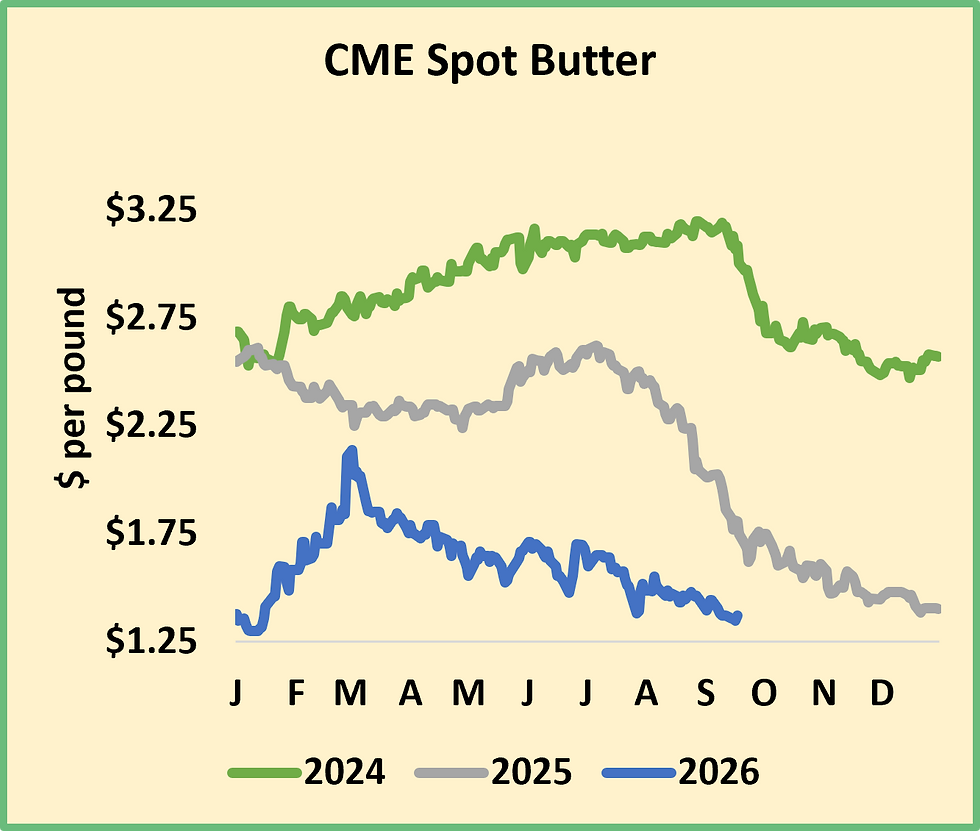
The butter market also looks weak. The world is simply drowning in milkfat. Butter prices fell 5.7% at the GDT, and anhydrous milkfat values declined 3%. At the CME spot market, butter slumped to an eight-month low on Thursday. Prices rebounded Friday and butter was able to finish the week right where it started, at an unimpressive $1.37.
The collapse in the cheese market dragged down Class III prices. The October through January contracts lost 45ȼ or more, and deferred contracts dropped roughly 20ȼ. September through January Class III are huddled around $16 per cwt., which is likely not enough to pay the bills. Deferred Class III futures forecast slightly better days ahead, with Q2 and Q3 contracts around $17.
Strength in the NDM market buoyed nearby Class IV futures. The October contract inched up 15ȼ to $19.65. But traders on LaSalle Street don’t expect milk powder prices to hold above $2 for long, and they’re worried about butter. December 2026 and all 2027 Class IV futures posted double-digit losses. Most Class IV futures contracts forecast milk revenues in the mid-$18s.
Grain Markets
The grain markets took a step back from the post-WASDE highs. Silage choppers and combines are rolling and farmers are hauling crops to the feed slab or their local elevator. They’re also selling the corn they had leftover from last year’s harvest and some of this season’s bushels to boot. The balance sheet is much tighter than it once was, but the market is still vulnerable to harvest pressure. December corn dropped a nickel to $5.27 per bushel.
Meanwhile, the soy complex strengthened. The bean crop is big, but so is demand. Crushers are running hard, and commodity firms are moving big volumes of U.S. soybean meal abroad. The market is also hopeful that next week’s trade summit between Presidents Trump and Xi could result in more Chinese purchases. But the Chinese seem more inclined to talk about issues beyond the farm. Nonetheless, soybean meal prices added another $5 this week and closed at $358.60 per ton.
The energy crisis is rippling through dairy producers’ expenses. Fuel surcharges are boosting the cost to harvest, process, and deliver crops. Dairy producers should brace themselves for higher futures prices and steeper markups. Costs are climbing quickly, and they’re likely to remain elevated.

Comments